The fifth installment of Guthlac A is now complete. I have been experimenting with ways to organize the vocabulary in a database, so that had slowed progress for a few days.
I know that there are a lot of computer people amongst you Anglo-Saxonists, so any suggestions of how to manipulate data in MS Excel would be greatly appreciated: I want to create a wordlist that preserves each form a word takes, but that swiftly eliminates duplicates and extremely common words, so I don't have to wade through them when I need to look for a word. For Guthlac, I can just use Roberts's glossary, but I'm looking ahead to a bigger poem like Genesis.
Thursday, August 21, 2008

Wednesday, August 20, 2008
Update to Elene
I've added about thirty lines to the Elene translation that were lying about. I don't really mean to do two poems at the same time--and Lord knows I have enough to do without it--but I did want to get everything I have out on the table.
I have not been satisfied with the sound of Elene so far, and so I have pushed it aside until I can digest a few more translations. There is something very different about the voice of the poem--Andreas and Guthlac A just don't have it-- and I need to get my mind around expressing it that voice.
I have not been satisfied with the sound of Elene so far, and so I have pushed it aside until I can digest a few more translations. There is something very different about the voice of the poem--Andreas and Guthlac A just don't have it-- and I need to get my mind around expressing it that voice.
Tuesday, August 19, 2008
Updates to Guthlac
The first four sections of Guthlac A are now complete, so please come and visit to check things out. I recently stumbled across Jane Roberts's 1979 edition and remembered that Bernard Muir's edition of the Exeter Book existed, so I now have a much more up-to-date edition to use in the translation. A relief, but one that will necessitate some revisiting of the notes so far, I fear.
Consequently a bibliographic list of editions and translations has been added to the start of the Notes section, just to help you all play along at home.
Consequently a bibliographic list of editions and translations has been added to the start of the Notes section, just to help you all play along at home.
Saturday, August 9, 2008
More Guthlac
The first three parts of Guthlac A are posted, and the notes sections is struggling along behind it. I feel that I am starting to get a feel for the poem's unique qualities: its heavily periodic structure that depends on very dense repetition, its unusual meter (Sievers types don't really help very much in many of the lines), and the poem's obsession with state and condition (as evidenced by the constant use of had, and the frequent use of legal terminology).
I hope you are enjoying the evolution of the translation as much as I am.
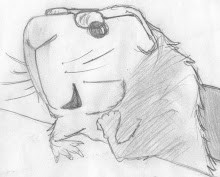
On another note, ASNPP just broke a minor landmark today. The page has had 1,005 hits, with 756 unique visitors. I still have a long way to go to catch up with In The Middle, and the guinea pig cartoon page has still had 8 times as many hits, but I am very proud this project has received so much interest. Thank you all!
Sunday, July 27, 2008
I'm back
Hello, gentle readers --
I am finally back from my summer travels (wedding, honeymoon, and moving into a new apartment) and thought that there should be some kind of new activity here.
So I will officially announce the creation of the Guthlac translation page, a poem that is often in my thought while carving through my current chapter on Sir Gowther. Format will follow the Andreas and Elene pages, and there will be (sporadic) activity on all three pages.
I thought I would urge you over to my first attempt to render the breathtaking, heart-rending beauty of the opening of Guthlac, a start of a poem that feels utterly unlike any other of the narrative poems. It seems inverted, as if the homiletic payoff is delivered right up front, one of the "lænan dreamas" (loaned pleasures) alluded to at the start of the poem, which the reader's continued attention for the rest of the poem (or poems) will repay.
So I promise your attention will be repaid in the near future. As usual, I humbly beseech your input, so please send along your comments and critiques.
Thursday, June 12, 2008
Hello again!
I have been negligent in updating lately. My apologies.
The first bit of news is that the Elene translation page is now receiving updates. The first 18 lines are already there. I'm trying to discover the voice of the poem, and get the hang of Cynewulf's style. I absolutely do not want this poem to sound like it was written by the Andreas-poet. Guthlac is also floating around in the mix, and will probably start getting some action as well (page to come).
The second item is the ASF2 panel went really well. I have notes to provide a more fleshed-out account which I will be working on.
And, third, the Andreas translation is receiving frequent edits as I start to hone the language and style. One thing that has been pointed out to me is that there are way too many commas -- so that's being fixed. Also, there are attempts at preserving kennings that need a lot of work to sound interesting, rather than just awkward.
Monday, May 19, 2008
ASF2 PT 2 -- The Translations
So here are the translations that I will be discussing during the roundtable at this week's Anglo-Saxon Futures conference. My main goal in translating the Ruin was to attempt to back off of the heavy-handed moralization that often gets read into the poem, which itself avoids that sort of language, and preserve the absolute vacuum of agency that exists within it. The poem is ambient and imagistic; it crackles with the energy of words that do not themselves signify actions or interntions. As in my Andreas translation, the lines tend to be long and spill over. For the mangled parts, I decided to try to accommodate the appearance of the poem from the manuscript. I had been staring at the facsimile of the pages reproduced in Anne Klinck's The Old English Elegies: A Critical Edition and Genre Study, and became fascinated with the disrupted architecture of the mise-en-page.
The Ruin
These wall-stones are wondrous —
crumpled by calamity, these city-sites crashed, the work of giants
corrupted. The roofs have rushed to earth, towers in ruins.
Ice at the joints has unroofed the barred-gates, sheared
the scarred storm-walls have disappeared—
the years have gnawed them from beneath. A grave-grip holds
the master-crafters, decrepit and departed, in the ground’s harsh
grasp, until one hundred generations of human-nations have
trod past. Subsequently this wall, lichen-grey and rust-stained,
often experiencing one kingdom after another,
standing still under storms, high and wide—
it failed—
The wine-halls moulder still, hewn as if by weapons,
penetrated [XXXXXXXXXXXXXXXXXXX]
savagely pulverized [XXXXXXXXXXXXXX]
[XXXX] shined [XXXXXXXXXX]
[XXXX] adroit ancient edifice [XXXXX]
[XXXXXXX] bowed with crusted-mud —
The strong-purposed mind was urged to a keen-minded desire
in concentric circles; the stout-hearted bound
wall-roots wondrously together with wire. The halls of the city
once were bright: there were many bath-houses,
a lofty treasury of peaked roofs, many troop-roads, many mead-halls
filled with human-joys until that terrible chance changed all that.
Days of misfortune arrived—blows fell broadly—
death seized all those sword-stout men—their idol-fanes were laid waste —
the city-steads perished. Their maintaining multitudes fell to the earth.
For that the houses of red vaulting have drearied and shed their tiles,
these roofs of ringed wood. This place has sunk into ruin, been broken
into heaps,
There once many men, glad-minded and gold-bright,
adorned in gleaming, proud and wine-flushed, shone in war-tackle;
There one could look upon treasure, upon silver, upon ornate jewelry,
upon prosperity, upon possession, upon precious stones,
upon the illustrious city of the broad realm.
Stone houses standing here, where a hot stream was cast
in a wide welling; a wall enfolding everything in its bright bosom,
where there were baths, heated at its heart. That was convenient,
when they let pour forth [XXXXXXXXX] over the hoary stones
countless heated streams [XXXXXXXXXXX] until the ringed pool
hot [XXXXXXXXXXXXXX] where there were baths
Then is [XXXXXXXXXXXXXXXXX]. That is a kingly thing—
a house [XXXXX],
a city
Durham is a different little bear: it shouldn't look or read like the Ruin or one of the narrative poems. For this one, I decided to stay with the basic line structure posited for Anglo-Saxon verse, but incorporated minor variations as I went. The poem has a breathy, accumulative, and... and-kind of structure that gives it an informal, casual and friendly feel.
Durham
Is this city famous throughout Britain’s realm,
of many steps founded, the stones without
wondrously have waxed. The Wear flows around it,
a river strong of wave, and therein dwell
myriad kind of fishes, mingled in the flood.
And there is grown up within a great wood-fastness;
where dwell within the city many wild beasts—
in the deep dales deer innumerable.
Also in that city there is well-known among her sons,
the mercy-fast, the blessed Cuthberg, and the head of the pure king,
Oswald, Lion of the English,* and Bishop Aidan,
Eadberh and Eadfrith, worthy companions.
There is among them, Aethelwold the bishop
and the famous scholar Bede, and Basil the abbot,
that taught the virginal Cuthbert in his youth fervently,
and Cuthbert took well to his lessons —
There dwells among the blessed in that minster also
relics uncountable,
where many are worthied, just as the Book says to do —
in their company a man of God can await his glory.
* or perhaps, Shelter (hleo) of the English, as in the common heroic epithet, hleo wiggendra, found in Andreas and Beowulf.
So we'll see how these go over at the roundtable. I'm really looking forward to learning a lot about how to translate the verse.
Subscribe to:
Posts (Atom)